





Memory Lane
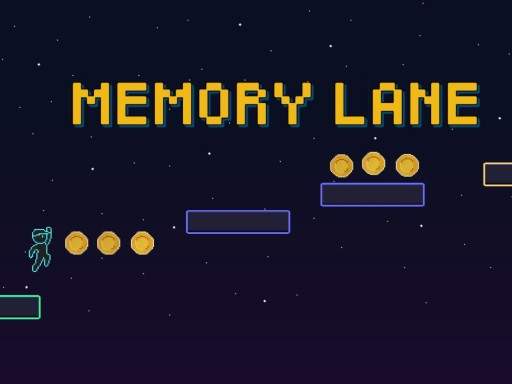















About game «Memory Lane»
Memory Lane Platformer Game – Reveal, Remember, Jump, and Reach the Goal
Welcome to a challenging memory-based platformer game where observation, timing, movement, and quick reflexes are just as important as traditional platforming skills. Your objective is simple: reach the Goal Platform without falling, touching enemies, or getting caught by dangerous traps.
What makes this platform game different is its unique two-phase gameplay system. Every level begins with a short Reveal Phase, allowing you to study the complete level layout. Once the preview ends, the game enters the Action Phase, where most platforms become invisible. You must rely on your memory to remember where platforms, hazards, enemies, pickups, and safe routes were located.
As you progress, touching an invisible platform reveals it permanently, gradually turning an unknown route into a visible path. Some platforms may also remain visible throughout the Action Phase, giving you important landmarks to help navigate the level.
This combination of memory challenges, precision platforming, invisible platforms, enemy avoidance, jumping mechanics, and power-ups creates a game experience that rewards both careful planning and fast reactions.
How Do You Play the Memory Platformer?
The goal of each level is to safely travel through the platform layout and land on the Goal Platform.
You must carefully observe the level during the Reveal Phase because the platform layout will change visually when the Action Phase begins. The safest route is not always the most obvious route, and a single missed jump can cause you to fall.
Before moving, study the level and create a mental map.
Remember:
- Where each platform is located.
- Which platforms are safe to land on.
- How far you need to jump between platforms.
- Where enemies are positioned.
- Where traps or other hazards appear.
- Where useful pickups are located.
- Which platforms remain visible.
- Where the Goal Platform is located.
- Which route gives you the safest path to the goal.
- Where you may need to change direction in midair.
- Whether a power-up can provide a double jump or another movement advantage.
The game is designed to test your ability to observe first and act second.
Phase A: Reveal Phase
Every level begins with a short preview called the Reveal Phase.
During this phase, the entire level layout is visible. You can see the platforms, gaps, hazards, enemies, pickups, and destination.
However, there is an important restriction:
You cannot move during the Reveal Phase.
Instead of immediately controlling your character, use these few moments to study the level.
Think of the Reveal Phase as a quick visual puzzle. Your job is to memorize enough information to navigate the level once the platforms disappear.
What Should You Memorize During the Reveal Phase?
The most important information is the route from your starting position to the Goal Platform.
Look for a sequence of platforms that your character can realistically reach.
For example, you may see:
Starting Platform → Low Platform → High Platform → Moving Route → Pickup → Final Platform → Goal Platform
The exact layout will vary by level, so there may not be one universal route.
When studying the level, pay special attention to the distance between platforms. A platform that appears close may require a carefully timed jump, while a seemingly distant platform may be reachable with a long jump or a powered-up movement ability.
Memorize Platform Locations
Try to remember platforms using their relationship to other objects instead of trying to memorize isolated coordinates.
For example, think:
- “The next platform is above and slightly to the right.”
- “The small platform is underneath the enemy.”
- “The safe platform is immediately after the large gap.”
- “The Goal Platform is near the upper-right side.”
- “The pickup is on the middle platform.”
- “The final jump requires moving left before jumping.”
This makes the level easier to reconstruct mentally once the platforms become invisible.
Identify Safe Platforms
Not every visible object necessarily represents a safe route.
Look for platforms that provide stable landing areas and allow you to prepare for the next jump.
A larger platform can be especially useful because it gives you more room to recover before your next movement.
Small platforms may require greater precision.
Watch for Enemies
Enemy locations are critical during the Reveal Phase.
Remember where enemies are positioned and how much space you need to avoid them.
The objective is not simply to reach the next platform. You must reach it without touching an enemy.
If an enemy occupies the area around a platform, consider whether you need to approach from above, below, or from the opposite side.
Look for Traps
Traps can turn an apparently safe route into a dangerous one.
During the preview, identify any visible hazards and remember their locations.
Do not assume that the shortest path is automatically the safest path.
A slightly longer route may be better if it provides wider platforms, fewer enemy encounters, or easier jumps.
Locate Pickups and Power-Ups
Pickups may provide useful advantages during a level.
If a power-up enables a double jump, remember its location and consider whether collecting it will make later sections easier.
A double jump can provide additional vertical or horizontal flexibility, particularly when the normal jump cannot reach a platform.
Phase B: Action Phase
After the Reveal Phase ends, the game enters the Action Phase.
This is where the memory challenge begins.
Most platforms from the preview become invisible unless they are specifically marked to remain visible.
You can no longer rely entirely on what you see.
Instead, you must use the mental map created during the Reveal Phase.
Invisible Platforms
Invisible platforms are one of the defining mechanics of the game.
A platform that you saw during the preview may still be physically present even though it is no longer visible.
This means you need to remember where you expect the platform to be.
If you successfully touch an invisible platform, it becomes permanently visible.
This creates an important progression mechanic.
At the beginning of the Action Phase, the route may be uncertain. As you successfully land on platforms, more of the path becomes visible.
The level therefore becomes easier to read as you progress, provided you avoid falling and enemies.
Touching a Platform Reveals It
When your character touches an invisible platform, that platform is revealed permanently.
Use this mechanic to gradually build a visible route toward the goal.
For example:
- Remember where the first platform is.
- Jump toward its remembered position.
- Land successfully.
- The platform becomes visible.
- Use the newly revealed platform as a visual reference.
- Continue toward the next remembered platform.
- Repeat until you reach the Goal Platform.
This system rewards players who combine memory with controlled exploration.
How to Reach the Goal Platform
The ultimate objective of every level is to reach the Goal Platform.
The Goal Platform should be identified during the Reveal Phase and remembered before the Action Phase begins.
Do not wait until the Action Phase to figure out where the goal is.
Instead, note its approximate location and determine the route that leads toward it.
A useful mental strategy is to break the level into sections.
For example:
Section 1: Starting area
Section 2: First invisible-platform sequence
Section 3: Enemy area
Section 4: Power-up section
Section 5: Final jumps
Section 6: Goal Platform
Breaking the level into smaller sections makes a complicated layout easier to remember.
Movement Controls
The game uses simple and responsive movement controls.
Move Left and Right
You can move your character using:
- A – Move left
- D – Move right
- Left Arrow – Move left
- Right Arrow – Move right
Use either the keyboard letters or arrow keys according to your preference.
Precise horizontal movement is particularly important when approaching small invisible platforms.
Jump
Press Space once to jump.
A normal jump can be used to move between platforms and cross gaps.
Timing is important. Do not simply hold a direction continuously and hope to land on the next platform.
Instead, combine horizontal movement with jump timing.
Higher Jump Arc
Hold Space for a higher jump arc.
This gives you additional control over jump height and can help you reach platforms that are positioned higher or farther away.
Understanding the difference between a quick jump and a held jump is important for mastering difficult levels.
Use a shorter jump when you need a controlled landing on a nearby platform.
Use a higher jump when you need additional vertical or horizontal reach.
Double Jump Power-Up
A Double Jump is available only when the appropriate power-up has been collected.
This means you should pay close attention to pickups during the Reveal Phase.
If you see a double-jump power-up, remember where it is and consider how it changes the rest of the level.
Once powered up, the double jump can give you another opportunity to correct your position while airborne.
This can be especially useful when:
- A platform is higher than expected.
- You slightly miss the first jump.
- You need extra vertical height.
- A gap is too wide for a standard jump.
- You need to avoid an enemy while airborne.
- You need to redirect your character toward a narrow platform.
Do not assume that the double jump makes the level automatically easy. You still need to remember the layout and control your movement carefully.
Mobile Controls
The game supports mobile devices with touch-based controls.
When playing on a smartphone or tablet, touch buttons appear automatically.
This means you do not need a physical keyboard to play.
Mobile players can use the on-screen movement and jump controls to navigate the level.
Because the game relies heavily on timing and precision, take a moment to become familiar with the mobile control layout before attempting the most difficult levels.
Memory-Based Platforming Strategy
The best way to improve at this game is to treat each Reveal Phase as a short planning session.
Do not spend the entire preview staring at the character.
Instead, scan the level systematically.
Step 1: Find the Goal
Locate the Goal Platform first.
Knowing the destination gives you a mental direction for the entire level.
Step 2: Find the Starting Route
Identify the first few platforms that can carry you away from the starting area.
Focus on the immediate path first rather than trying to memorize every platform simultaneously.
Step 3: Mark Dangerous Areas Mentally
Remember enemy and trap locations.
Dangerous areas deserve more attention than empty space.
Step 4: Identify Pickups
Locate power-ups and other useful pickups.
A power-up may change the best route through the level.
Step 5: Divide the Level Into Sections
Instead of memorizing the entire level as one image, create several smaller mental sections.
For example:
- Start
- First gap
- Enemy zone
- Pickup
- Vertical climb
- Final route
- Goal
Step 6: Remember Direction Changes
Direction changes are particularly important.
If the route goes right, then left, then right again, remember the sequence.
A simple mental rhythm such as:
Right → Right → Left → Jump → Right
can sometimes be easier to remember than the entire visual layout.
Step 7: Begin the Action Phase Carefully
The first jump is often the most important because it establishes your position.
Avoid unnecessary movement.
Use controlled jumps and let revealed platforms become your new visual landmarks.
Tips for Avoiding Falls
Falling is one of the primary dangers in a memory platformer.
Because platforms become invisible, you may sometimes need to jump toward a location where you cannot currently see a platform.
The solution is to trust the information you collected during the Reveal Phase.
Use Platform Relationships
Instead of thinking only in terms of exact positions, remember relationships.
For example:
“The second platform is above the right edge of the first platform.”
This can help you estimate where to move even after the visual information disappears.
Control Your Horizontal Movement
Avoid holding left or right for too long when approaching a narrow platform.
Small corrections can make the difference between landing safely and falling.
Do Not Panic When a Platform Is Invisible
An invisible platform may still be exactly where you remember it.
If you know that a platform exists below your expected landing point, stay calm and adjust your movement accordingly.
Use Revealed Platforms as Landmarks
Every platform that becomes visible again gives you more information.
Use it to recalibrate your position.
You do not need to rely exclusively on your initial memory once several platforms have been revealed.
Tips for Avoiding Enemies
Enemies are hazards that can end a successful run even when your platforming is accurate.
During the Reveal Phase, identify where enemies are located.
Then remember the safest approach.
Give Enemies Space
Do not try to squeeze through a tiny gap between an enemy and a platform unless the level clearly requires it.
A safer route is usually preferable.
Consider Your Jump Arc
An enemy may be positioned at the same horizontal location as a platform.
In that situation, jumping directly toward the platform may cause a collision.
Instead, consider whether you can approach the platform from above or from the opposite side.
Use Power-Ups Strategically
If a double jump is available, it may give you additional options for avoiding an enemy.
The key is to remember the power-up location before the Action Phase begins.
Tips for Handling Invisible Platforms
Invisible platforms are not random obstacles. They are part of the memory challenge.
The level was visible before the Action Phase began, so you have already been given the information needed to navigate.
Memorize the Order
Try to remember the approximate order of platforms.
For example:
Large → Small → Small → Large → High → Goal
This sequence can help you reconstruct the path.
Remember Vertical Position
It is useful to know whether the next platform is:
- Above you
- Below you
- At the same height
- Far above
- Slightly below
- To the left
- To the right
Combining vertical and horizontal information creates a stronger mental map.
Use Successful Landings
Once a platform is revealed after contact, you no longer need to remember its exact position.
Focus your memory on the remaining invisible platforms.
This reduces the amount of information you need to hold in your mind as you progress.
Why the Reveal Phase Matters
The Reveal Phase is more than a loading screen or visual preview.
It is a fundamental part of the gameplay.
The game deliberately separates observation from execution.
During the Reveal Phase, you gather information.
During the Action Phase, you apply that information.
This creates a gameplay loop based on:
Observe → Memorize → Plan → Move → Reveal → Adapt → Reach the Goal
The mechanic encourages players to slow down before acting and rewards careful observation.
Is This Game a Memory Game or a Platformer?
It is both.
The game combines the core mechanics of a platformer with a memory challenge.
Traditional platform games generally allow you to see the platforms you are jumping toward.
Here, the player must remember platforms after they become invisible.
That means success depends on multiple skills:
- Visual memory
- Spatial awareness
- Reaction time
- Jump timing
- Horizontal movement control
- Risk assessment
- Enemy avoidance
- Route planning
- Adaptation
This combination makes each level more than a simple jumping challenge.
What Makes the Gameplay Challenging?
The main challenge comes from limited visual information during the Action Phase.
You know the platforms exist because you saw them during the preview, but you cannot necessarily see them while moving.
This creates uncertainty.
You may remember that a platform is supposed to be somewhere ahead, but you still need to control your jump precisely enough to land on it.
The game therefore tests both what you remember and how accurately you can execute your plan.
A player with excellent memory but poor movement control may fall.
A player with excellent platforming skills but poor memory may jump toward the wrong location.
The strongest players combine both.
Beginner Tips
If you are playing for the first time, start by focusing on a few key pieces of information rather than trying to memorize every detail.
A good beginner strategy is:
- Find the Goal Platform.
- Find the first safe platform.
- Memorize the next two or three platforms.
- Identify nearby enemies.
- Identify the most important pickup.
- Remember the direction of travel.
- Begin moving carefully.
- Use revealed platforms as visual landmarks.
- Continue memorizing the next section as you progress.
- Save risky jumps for when they are necessary.
You do not need a perfect memory to play successfully.
You need a reliable method for organizing the information you see.
Advanced Strategy
Experienced players can optimize their runs by memorizing the level as a complete route.
Rather than thinking of individual platforms separately, build a continuous path.
For example:
Start → Right jump → Upper platform → Left correction → Enemy avoidance → Pickup → Double jump → High platform → Final jump → Goal
This approach lets you anticipate movement before each jump.
Advanced players should also consider jump height.
If a platform is positioned high above the character, a held Space input may be necessary.
If the next platform is close, a shorter jump may provide greater control.
The best route is therefore influenced by both platform position and movement mechanics.
How to Master the Double Jump
Once you have obtained the required power-up, practice using the second jump deliberately.
Do not immediately use the double jump every time you leave the ground.
Instead, think of it as a backup movement option.
A useful strategy is:
First jump = primary movement
Second jump = correction, extension, or avoidance
This gives you greater control.
For example, if your first jump carries you slightly too far to the left, the second jump may allow you to redirect toward the target platform.
Likewise, a double jump can help when an enemy occupies part of the normal landing route.
Common Mistakes
Moving Before Understanding the Route
The game is specifically designed around the Reveal Phase.
Use it.
Trying to rush through the Action Phase without studying the level will usually make the game harder.
Memorizing Only the Goal
Knowing where the Goal Platform is does not tell you how to reach it.
Remember the platforms and hazards between your starting location and the goal.
Ignoring Enemy Locations
A platform can be safe from falling but dangerous because of an enemy.
Always consider both hazards.
Holding a Direction for Too Long
Continuous horizontal movement can cause you to overshoot small platforms.
Use controlled inputs.
Forgetting Power-Ups
A double-jump power-up can significantly affect your route.
Remember its location during the Reveal Phase.
Panicking When Platforms Disappear
Invisible does not mean absent.
Trust your memory and use successful platform contacts to rebuild the visible route.
Frequently Asked Questions
What is the objective of the game?
The objective is to reach the Goal Platform without falling or touching enemies.
Why do the platforms disappear?
Most platforms become invisible during the Action Phase to create a memory-based challenge.
Can invisible platforms still be landed on?
Yes. Invisible platforms remain part of the level even when they are not visually displayed.
How do I reveal an invisible platform?
Touching an invisible platform reveals it permanently.
Can revealed platforms disappear again?
Platforms that are revealed by touching them remain visible permanently for that level.
Can I move during the Reveal Phase?
No. The Reveal Phase is designed for observation and memorization. Movement is disabled.
What should I look for during the preview?
Look for the Goal Platform, safe platforms, gaps, enemies, traps, pickups, power-ups, and the safest route through the level.
How do I jump?
Press Space once to jump.
How do I jump higher?
Hold Space to create a higher jump arc.
How do I move left and right?
Use A and D or the Left and Right Arrow keys.
Is a double jump always available?
No. Double jump is available only when you have obtained the appropriate power-up.
Does the game support mobile devices?
Yes. Mobile touch controls appear automatically on supported mobile devices.
Do I need a keyboard to play on mobile?
No. Mobile devices use the automatically displayed touch controls.
What happens if I touch an enemy?
Touching an enemy is a failure condition for the level and should be avoided.
What happens if I fall?
Falling prevents you from reaching the Goal Platform safely and requires you to retry the level according to the game’s restart system.
Are all platforms invisible?
Not necessarily. Platforms marked to remain visible can stay visible during the Action Phase. Other memory-phase platforms become invisible until touched.
Is the game based on memorization?
Yes. Memorization is a central mechanic because players must remember the level layout during the Reveal Phase and use that information during the Action Phase.
Is the game suitable for beginners?
Yes. Beginners can learn the mechanics gradually by studying the preview carefully and using revealed platforms as visual landmarks.
What skills does the game test?
The game tests spatial memory, visual observation, timing, coordination, reflexes, route planning, movement control, and hazard avoidance.
Quick Controls Guide
| Action | Control |
|---|---|
| Move Left | A or Left Arrow |
| Move Right | D or Right Arrow |
| Jump | Tap Space |
| Higher Jump | Hold Space |
| Double Jump | Available with power-up |
| Mobile Movement | Automatic touch controls |
| Mobile Jump | Automatic touch controls |
Quick Gameplay Guide
For players who want the shortest possible explanation:
1. Watch the level.
During the Reveal Phase, all platforms and hazards are visible.
2. Memorize the route.
Remember platform positions, enemies, traps, pickups, and the Goal Platform.
3. Wait for the Action Phase.
Most platforms become invisible.
4. Move using memory.
Use A/D, Arrow keys, or mobile touch controls.
5. Jump carefully.
Tap Space for a normal jump and hold Space for a higher jump.
6. Collect power-ups.
A suitable power-up can unlock the double-jump ability.
7. Reveal platforms.
Touching an invisible platform makes it permanently visible.
8. Avoid hazards.
Do not fall and do not touch enemies.
9. Reach the Goal Platform.
Successfully complete the level by reaching the goal.
Memory Platformer Gameplay Loop
The core gameplay loop can be summarized as:
REVEAL
See the complete level.
↓
OBSERVE
Study platforms, enemies, traps, pickups, and the goal.
↓
MEMORIZE
Create a mental map of the safest route.
↓
ACTION
The level becomes partially invisible.
↓
JUMP
Use precise movement and timing to navigate.
↓
REVEAL
Touch invisible platforms to make them permanently visible.
↓
ADAPT
Use newly revealed information to improve your route.
↓
GOAL
Reach the Goal Platform without falling or touching enemies.
SEO-Friendly Game Overview
This memory platformer game combines classic jumping mechanics with invisible platforms and a unique reveal-and-remember system. Players begin each level with a short preview where the complete platform layout is visible. During this period, players cannot move, giving them time to study the level and memorize the route.
Once the Action Phase starts, most platforms become invisible. Players must then rely on their memory, spatial awareness, and platforming skills to navigate the level. Successfully touching an invisible platform reveals it permanently, allowing players to progressively reconstruct the level while moving toward the goal.
The game features keyboard controls, adjustable jump height through Space input, a double-jump power-up, enemy hazards, traps, pickups, invisible platforms, permanently visible platforms, and automatic touch controls for mobile devices.
Whether you enjoy platform games, memory games, reflex challenges, puzzle platformers, precision jumping, invisible platform games, or skill-based arcade gameplay, this experience combines those mechanics into a single challenge.
Why Players May Enjoy This Platformer
This game is designed for players who enjoy challenges that require more than simply pressing buttons quickly.
The Reveal Phase encourages observation.
The Action Phase rewards memory.
The platforming mechanics test timing.
The enemies test awareness.
The invisible platforms test confidence.
The power-ups add strategic options.
The Goal Platform provides a clear objective.
Together, these systems create a compact but challenging gameplay experience where every successful jump feels meaningful.
Search Intent and Answer Engine Summary
For players searching for a memory platformer game, the core answer is:
A memory platformer is a platform game where players must memorize the level layout before navigating it. In this game, the level begins with a short Reveal Phase in which all platforms are visible and movement is disabled. During the Action Phase, most platforms become invisible, requiring players to remember their locations and navigate using memory and reflexes. Touching an invisible platform makes it permanently visible. The objective is to reach the Goal Platform without falling or touching enemies.
For players searching for how to play an invisible platform game, the basic process is:
- Observe the level during the preview.
- Memorize the platform layout.
- Remember enemy and trap positions.
- Locate pickups and power-ups.
- Identify the Goal Platform.
- Navigate during the Action Phase using your memory.
- Touch invisible platforms to reveal them permanently.
- Use Space for jumping and hold Space for a higher jump.
- Use the double jump after obtaining its power-up.
- Reach the Goal Platform without falling or touching enemies.
For players searching for memory game platformer controls, use A/D or Left/Right Arrow keys to move, Space to jump, and hold Space for a higher jump arc. Mobile players automatically receive touch controls.
Game Challenge: Memory + Reflexes + Precision
Unlike a conventional platform game where every obstacle remains visible, this game asks players to remember information before executing their movement.
That creates a distinctive combination of:
Memory + Platforming + Timing + Reflexes + Strategy
The Reveal Phase answers the question:
“Where are the platforms and hazards?”
The Action Phase asks:
“Can you remember them well enough to reach the goal?”
This simple transition creates the central challenge of the game.
Best Way to Think About Each Level
Imagine that every level is a map.
During the Reveal Phase, you are looking at the map.
During the Action Phase, the map is partially removed.
Your task is to navigate using the map you remember.
The more effectively you memorize the level, the less you need to guess.
This is why careful observation can be just as valuable as fast reactions.
Recommended Player Mindset
Do not treat the Reveal Phase as wasted time.
Treat it as your preparation period.
Do not treat invisible platforms as random.
Treat them as platforms you have already seen.
Do not treat the Action Phase as a blind jump.
Treat it as the execution of a route you planned moments earlier.
Do not panic after one platform disappears.
Use your memory and the platforms you have already revealed.
Do not always choose the shortest route.
Choose the route that you can execute reliably.